
Knockout Cuisine
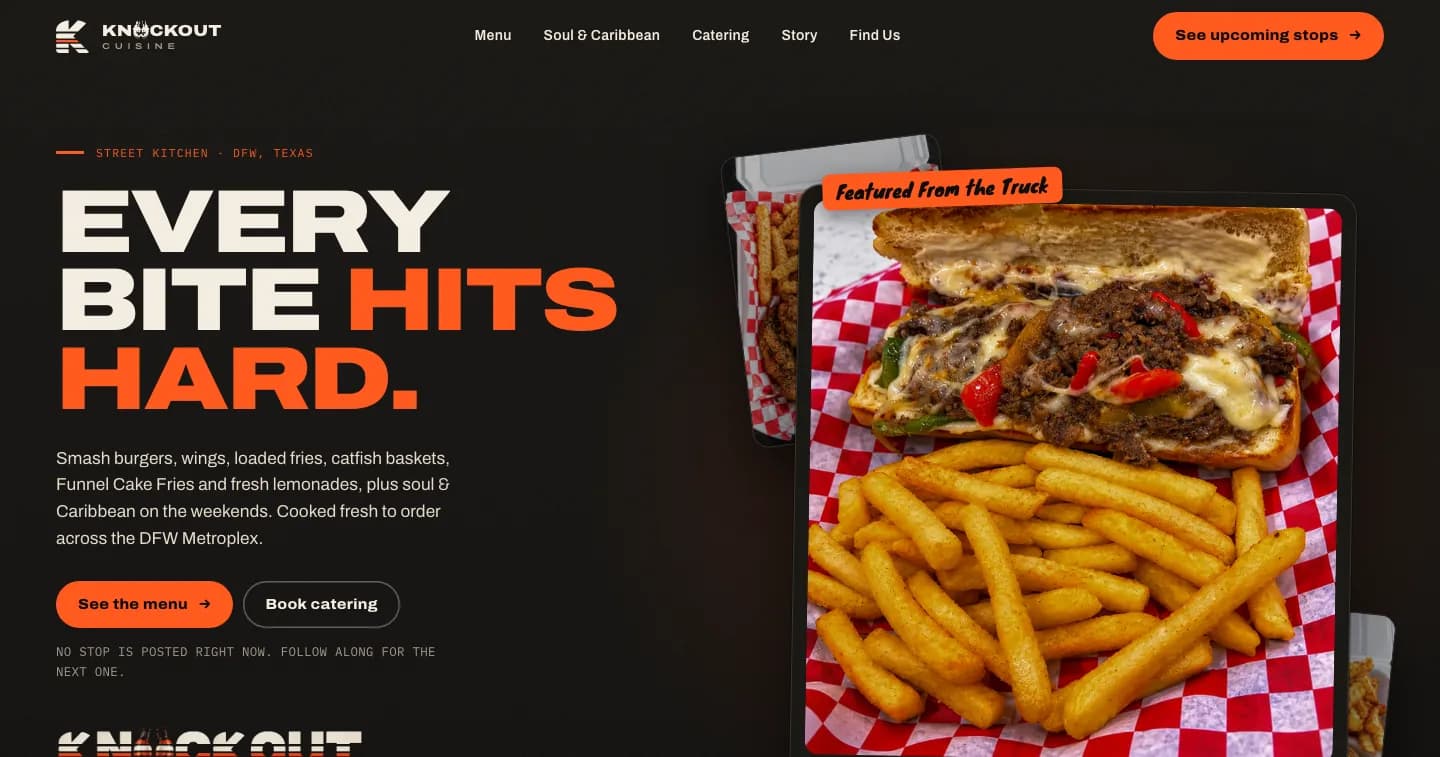
A DFW food truck gets one trustworthy home for its menu, stops and catering — run from Operion Food Truck OS, where the owner posts each stop, prices its menu, and opens preorders or live ordering when the truck is ready.
- My role
- Sole designer and developer — the brand application, the public site and truck board, Operion Food Truck OS, the ordering and payment path, email, security review, and the launch onto the client's own domain.
- Built for
- Food & hospitality
- Project type
- Food truck website, ordering & Operion Food Truck OS
- Built with
- Next.js · TypeScript · Supabase (auth + Postgres with row-level security) · Square · Resend · Vercel
The story
What problem existed, and what we built.
The problem
Customers couldn't find one menu, one set of hours or one place to ask about catering. Three menu sources disagreed, no hours were published, and catering requests had no form to land in. For a truck that moves, the hardest question — where is it today, and can I order — had no reliable answer.
What I built
A public site built around the truck's real schedule, backed by Operion Food Truck OS: the operations side of the Operion platform, configured as a food-truck workspace for Knockout Cuisine. The owner builds the menu once, posts each stop with its own prices and sides, and decides when ordering opens. Customers see a live truck board for that stop and order from it; catering inquiries arrive in the dashboard and are answered with versioned quotes.
What it had to achieve
- Give customers one answer to “what's on the menu and where is the truck”
- Only let customers order when the owner has actually opened ordering for a stop
- Make catering a pipeline instead of missed DMs
- Keep the truck's brand on everything a customer sees
The customer's experience
A customer checks the site, sees the next stop and opens its truck board. When preorders or live service are open, they tap an item, pick the sides, pay by card and get an email confirmation. When ordering is closed, the same board says so and points to the next stop. Event organizers fill in a catering form instead of hunting for a phone number.
What customers can do
- The menu, upcoming stops and catering in one place
- A Live Truck Board for each stop, styled like the truck's dry-erase board, with sold-out items crossed off
- Preorders or live ordering for a stop, only when the owner has opened it
- Card payment through Square, with order and receipt email
- A catering inquiry form that lands in the owner's dashboard
The owner & staff experience
The owner signs into Operion Food Truck OS, posts a stop, chooses which items it carries, sets and approves each stop price, verifies the sales tax, and opens preorders or goes live. During service, orders come into a queue and anything that runs out is marked sold out in a tap. Catering inquiries sit in their own list, each with notes and a quote the owner can revise and send.
What the business can do
- Operion Food Truck OS — a command center for what needs attention today
- Stops with an address, Central-time service window, pickup instructions and ordering mode
- A menu of categories, items and required sides, priced and approved per stop
- Sold-out controls and an order queue during service
- Catering inquiries with notes and versioned quotes
- Owner-only switches for payments and online ordering, and an append-only activity log
How it works
Architecture & integrations.
How the application, data, access controls, and connected services work together.
Operion runs the back of the truck
The dashboard is Operion Food Truck OS — Operion's operations shell configured as a food-truck workspace for Knockout Cuisine. Operion appears only behind the sign-in; every page, email and receipt a customer sees is Knockout Cuisine.
The database decides when ordering is open
Whether a stop can take orders comes from the server's clock and the owner's settings, never from the customer's phone. Every price, side, quantity and limit is checked again when the order is placed.
Rules enforced at the database
Opening ordering, approving prices and verifying tax are owner actions, enforced by the database itself rather than by hiding buttons. Activity is recorded in an append-only log.
A watchdog on the money
Every five minutes a check looks for a payment-provider failure or a payment that was never confirmed, and pauses ordering automatically until the owner turns it back on.
Design decisions
The choices that shaped it — and why.
Prices belong to the stop
A festival and a weeknight stop can price differently, so each stop carries its own approved prices and sides. Nothing is sold at a price the owner hasn't approved for that stop.
A board, not a catalog
The ordering page looks like the board on the side of the truck: compact rows of name and price, with sold-out items crossed out rather than hidden, so customers see what they missed and what's still there.
Real food, real footage
The site uses the owner's own photos and video from the truck, not stock food photography.
How it was built
Development process
- 1Audited the existing site and social accounts, and confirmed the operating model with the owner
- 2Built the public site from the owner-approved design and logo
- 3Built Operion Food Truck OS: menu, stops, catering inquiries and quotes
- 4Added stop ordering, the Live Truck Board, Square payments and transactional email
- 5Ran security reviews and backup rehearsals, then launched on knockoutcuisine.org
Technical overview
Technology & implementation
Technology stack
- Next.js
- TypeScript
- Supabase (auth + Postgres with row-level security)
- Square
- Resend
- Vercel
Implementation scope
Sole designer and developer — the brand application, the public site and truck board, Operion Food Truck OS, the ordering and payment path, email, security review, and the launch onto the client's own domain.
Related projects
You might also want to see
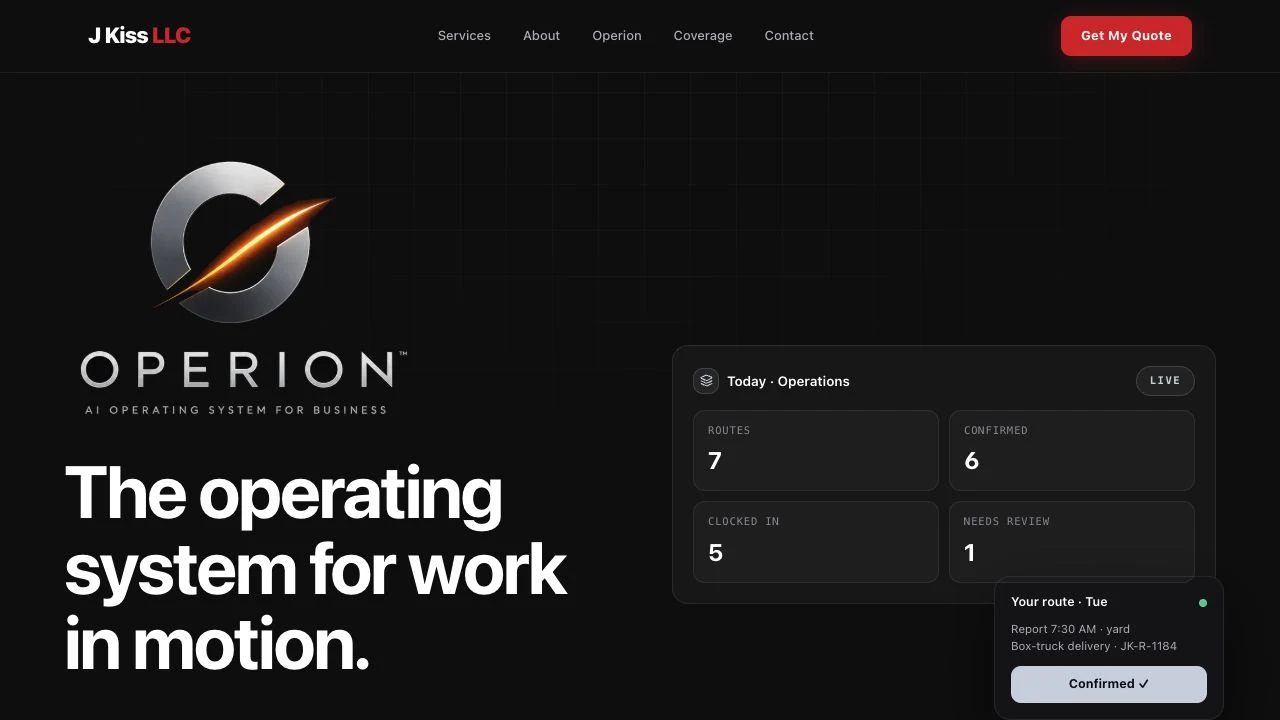
Operion
Multi-tenant operations platform · Project
www.jkissllc.com/operionThe operations platform built inside J Kiss LLC, with multi-company support designed in. J Kiss runs on the primary deployment; Supercharged Enterprise runs an adapted copy from its own codebase.
Read the case study
Pop That Pantry
Pre-launch site with an owned subscriber list · Client project
popthatpantry.comA food brand's pre-launch page built on the client's own brand system — with a subscriber list she owns outright rather than rents from a marketing platform.
Read the case studyWant something like this for your business?
Tell me how your days go and what you'd like to stop doing by hand. I'll tell you honestly what would help.